Station Casinos Surprises Nearly 10,000 Employees with Over $70 Million in Stock Awards for 50th Anniversary

The era of the traditional gold watch and guaranteed corporate pension may largely belong to the history books, but a notable exception is unfolding in the heart of the Las Vegas hospitality and gaming sector. In a striking move that prioritizes workforce equity over conventional milestone celebrations, Station Casinos recently stunned its labor force by distributing more than $70 million in company stock. Nearly 10,000 full-time and part-time employees received ownership stakes valued at $1,000 for every year they have dedicated to the organization, transforming frontline workers into corporate stakeholders overnight.
This unprecedented distribution, executed to mark the enterprise’s milestone golden anniversary, underscores a growing, albeit rare, corporate philosophy: that long-term employee retention and dedication should be met with tangible, wealth-building rewards. As labor markets shift and employee expectations evolve, the massive equity injection serves as a compelling case study in modern corporate appreciation.
A Landmark Announcement and Immediate Impact
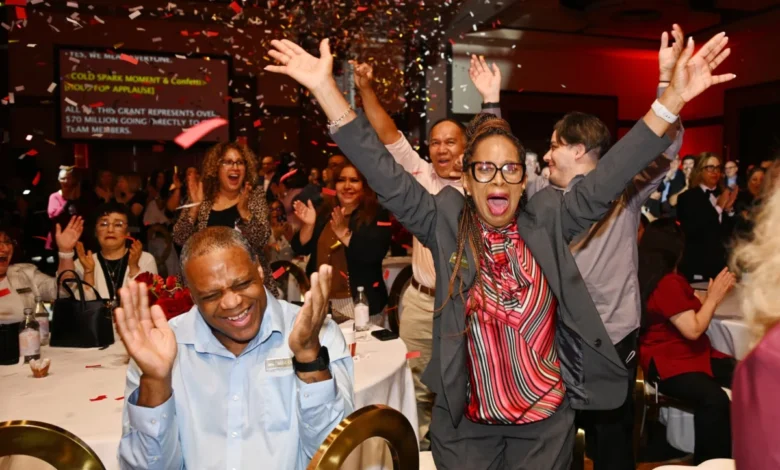
The reveal took place inside a crowded Las Vegas ballroom, where executives gathered the workforce to share the surprise. Frank Fertitta III, chairman and chief executive officer of Red Rock Resorts—the parent company of Station Casinos—alongside Vice Chairman Lorenzo Fertitta, delivered the news directly to the staff. Under the terms of the program, any individual actively employed as of the announcement date is eligible to receive $1,000 in Red Rock Resorts Class A common stock for each year of completed service.
For the average employee, the award represents a substantial financial windfall. However, for those who have weathered decades of growth alongside the Fertitta family, the rewards are life-changing. Ida Johnson, an exemplary team member who began her tenure with the company in 1977, was awarded $49,000 in equity. Similarly, six other legacy employees who launched their careers at the company’s original properties during the 1970s each received upwards of $45,000 in stock.
Eligible workers gained the ability to officially claim their shares at the start of the following week. During the announcement, Lorenzo Fertitta emphasized the psychological and practical shift the program aims to achieve. He noted that management wanted employees to view themselves not merely as workers punching a clock, but as actual owners with a vested interest in every guest interaction and operational shift.
From Humble Beginnings: The Chronology of Station Casinos
To fully understand the magnitude of the $70 million stock distribution, it is necessary to examine the half-century trajectory of Station Casinos. The enterprise’s foundation was laid in 1959, when founder Frank Fertitta Jr. relocated from Galveston, Texas, to Las Vegas, a city then rapidly defining itself as the entertainment capital of the world.
After years of gaining industry experience, the elder Fertitta opened his inaugural independent gaming establishment in 1976. Known simply as "The Casino," the modest 5,000-square-foot property featured a relatively modest footprint: 100 slot machines, six table games, and a total workforce of 90 employees.
The subsequent evolution of the company highlights its steady, calculated expansion throughout the Las Vegas Valley:
- 1976: Frank Fertitta Jr. opens "The Casino," establishing the company’s core ethos of localized hospitality.
- 1977: The property is rebranded as Bingo Palace, reflecting shifting consumer entertainment trends.
- 1984: The venue undergoes another major transformation, officially becoming Palace Station, which serves as the operational springboard for future regional growth.
- 1990s and 2000s: The company aggressively expands beyond its flagship neighborhood footprint, developing and acquiring major local properties.
- Modern Era: Station Casinos operates 14 distinct properties across the Las Vegas Valley, including Red Rock Casino Resort Spa, Green Valley Ranch Resort Spa Casino, and the newly established Durango Casino & Resort, alongside interests in various smaller venues.
Corporate Values and Leadership Philosophy
Throughout its transition from a single 5,000-square-foot gaming hall to a sprawling regional powerhouse, leadership has consistently pointed to a distinct set of guiding principles. According to Frank Fertitta III, his father recognized early on that sustainable success in the hyper-competitive hospitality industry relies entirely on the quality of the team members and the authenticity of guest relations.
In statements following the anniversary celebration, leadership reiterated that the company’s endurance over five decades is a direct result of frontline dedication. By structuring the anniversary bonus as equity rather than a one-time cash payout, the organization has tied the future financial well-being of its workforce directly to the long-term performance and valuation of Red Rock Resorts stock.
This approach attempts to bridge the historical gap between executive compensation and frontline labor. While corporate executives routinely receive equity-based incentives as standard compensation packages, extending meaningful stock ownership to hourly and part-time hospitality workers remains an exceptional practice within corporate America.
Broader Economic Trends and Industry Comparisons
Station Casinos is not entirely alone in its pursuit of broad-based employee equity, though such initiatives remain the exception rather than the rule. In recent years, a handful of major corporations have deployed significant equity pools to reward staff outside the traditional C-suite framework.
Notably, Bank of America previously distributed a restricted-stock pool valued at approximately $1 billion to nearly its entire global workforce. Similarly, following broad legislative and tax changes, Apple granted the majority of its global employees standard stock bonuses valued at $2,500. More recently, technology giant Samsung introduced plans to award thousands of dollars in shares to non-executive staff. Meanwhile, in the manufacturing sector, the family-owned operators of Louisiana-based Fibrebond Corp. made headlines by establishing a $240 million bonus pool—averaging roughly $443,000 per employee—upon the company’s sale.
These disparate examples highlight an ongoing conversation among economists, labor experts, and corporate boards regarding wealth distribution. As income inequality remains a central socio-economic concern, programs that broaden equity ownership are increasingly viewed as innovative tools for talent retention, morale building, and corporate social responsibility.
Analysis of Implications and Future Outlook
The decision by Station Casinos to distribute $70 million in equity carries several important implications for the regional gaming market and the broader service industry.
First, in a tight labor market where hospitality and gaming sectors frequently grapple with elevated turnover rates, substantial equity awards create an unprecedented incentive for employee retention. Workers who hold thousands of dollars in unvested or newly accessible company stock possess a tangible financial motivation to maintain their employment continuity.
Second, aligning employee success with shareholder value can fundamentally alter workplace culture. When frontline staff members hold equity, operational efficiency, customer service quality, and waste reduction can theoretically improve, as employees recognize that corporate profitability directly affects their personal net worth.
However, financial analysts also note potential challenges inherent in equity-based rewards for hourly workers. Stock market volatility means that the realized value of these awards can fluctuate significantly based on broader economic conditions, sector performance, and company-specific earnings reports. Furthermore, tax implications associated with the immediate receipt of shares require careful navigation for workers accustomed to traditional payroll structures.
As Station Casinos looks toward its next half-century of operation in the Las Vegas Valley, the anniversary stock distribution stands as a definitive statement of intent. By converting thousands of hospitality workers into corporate owners, the company has not only honored its historical roots but has also established a high-profile benchmark for employee compensation within the modern service economy.